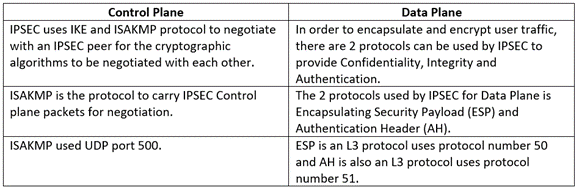
We need to understand that there are 2 types of traffic that we need to be aware of while configuring IPSEC.
Control Plane – Traffic generated and destined by/for VPN Device to set up a secure tunnel.
Data Plane- Traffic generated by User Endpoint in plain text, can be destined for another remote user/server.
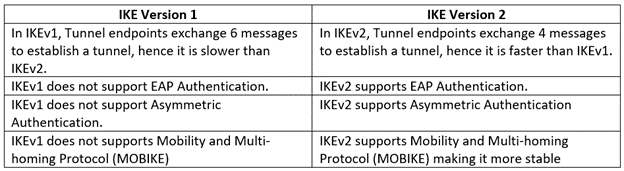
Before setting up the control plane, you need to decide the IKE version to be used. There are 2 versions of IKE available. IKE Version 1 and IKE Version 2.
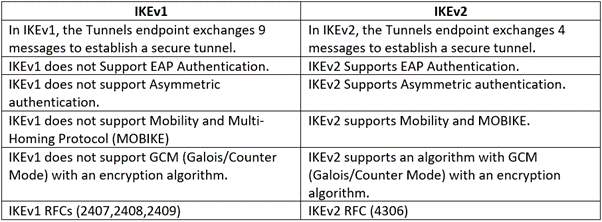
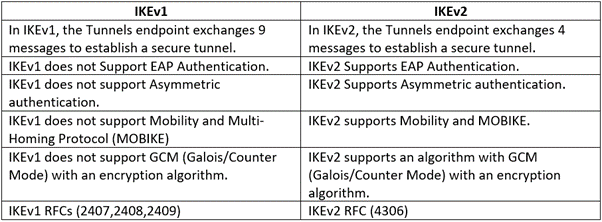
IKEv2 is better than IKEv1. Below mentioned are the basic differences between IKEv1 and IKEv2.
We will understand the packets exchanged by IKEv1 in this blog. IKEv2 is just an enhanced version of IKEv1, if IKEv1 is clear then IKEv2 is just a piece of cake.
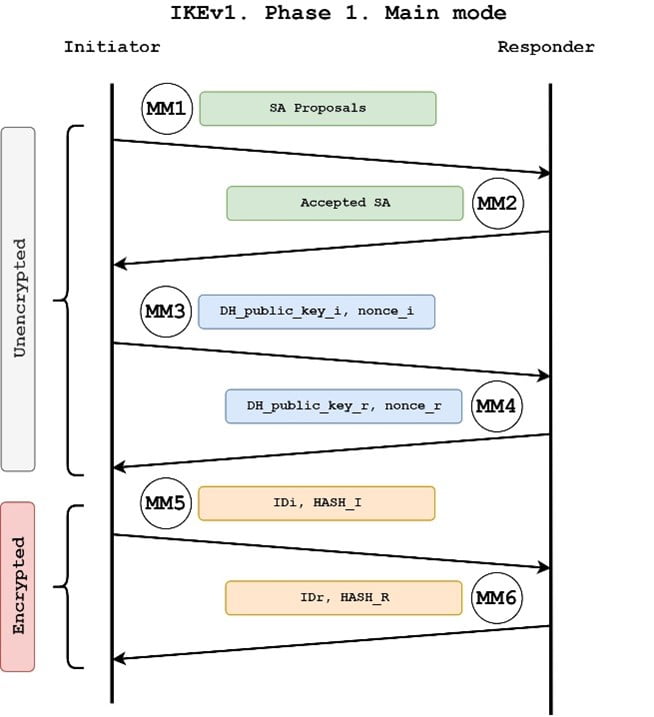
There are 2 phases and modes in IKEv1. Phase-1 is known as Main Mode and Phase-2 is known as Quick Mode. There is a total of 9 messages that get exchanged in IKEv1 out of which 6 messages get exchanged in Phase-1 (Main Mode) and the remaining 3 messages get exchanged in Phase-2 (Quick Mode).
Phase-1 (Main Mode)
Main Mode Message-1: The very 1st packet is sent by Initiator Tunnel Endpoint to Responder Tunnel Endpoint. This message contains the proposal of the Security Association which contains the Encryption, Hashing, Authentication, DH group, and Lifetime. Also, this message contains the Initiator cookie. This message is unencrypted.
Main Mode Message-2: The 2nd packet is sent by Responder Tunnel Endpoint to Initiator Tunnel Endpoint in response to the 1st message. This message contains the Encryption, Hashing, Authentication, DH group, and Lifetime proposed by Responder. Also, this message contains the Initiator cookie as well as the Responder cookie. This message is unencrypted.
Main Mode Message-3: If the algorithms shared in the Message-2 match with the Initiator, then only Initiator will proceed further with the 3rd packet. In the 3rd packet, Initiator sends a Diffie Hellman Public key along with the Nonce Key of Initiator. This message is unencrypted.
Main Mode Message-4: Responder replies with its Diffie Hellman Public key and the Nonce key of the responder. This message is unencrypted.
Main Mode Message-5: Initiator sends an ICV/Digest/Hash Value of its own Preshared key in encrypted format for authentication. This message is encrypted.
Main Mode Message- 6 Responder sends an ICV/Digest/Hash Value of its own Preshared key in encrypted format for authentication. This message is encrypted.
Once the Hash value (digest of Preshared Key) matches on the IPSEC peers, they move further to the 2nd Phase of IKEv1 i.e. Quick Mode.
Before moving on to the Quick Mode, You must be thinking about what the Nonce Key is, Initiator/Responder Cookie, Diffie Hellman Public key. So, Nonce Key and Cookie are the random values generated by both Initiator and responder. These keys help in generating the Session Key IDs which will be ultimately used for encrypting the further IKE messages, encrypting the data plane (ESP) traffic, integrity check of data plane packets using HMAC. DH we know as an Asymmetric Algorithm used for key exchange and generating the common shared secret.
Below mentioned are the Session Key IDs that get generated on both the tunnel endpoints after the 4 messages are exchanged. Session Key ID is a number created by a mathematical algorithm called “Pseudo-Random function (prf)”. Below mentioned are the formulas of SKEYIDs.
SKEYID= prf (Pre Shared Key + Nonce Value of Initiator + Nonce Value of Responder).
This Session Key ID will be the same on both the IPSEC peers because both have the same preshared key and Nonce Values exchanged during the 3rd and 4th packet.
SKEYID_D= prf (SKEYID + Initiator Cookie sent in 1st packet + Responder Cookie sent in 2nd packet + Shared Secret generated by the Diffie Hellman algorithm after exchanging Public Keys in 3rd and 4th Message). This SKEYID_D will be used for encrypting and decrypting the data plane traffic encapsulated with ESP.
We know that there is a total of 9 packets get exchanged in IKEv1 to set up the tunnel for the data plane. As of now, 4 packets are exchanged which were unencrypted but from the 5th packet, all remaining packets will be encrypted. For encryption we need a key, This SKEYID_E will be used for encrypting ISAKMP Packet 5 to ISAKMP Packet 9.
Phase-2 (Quick Mode)
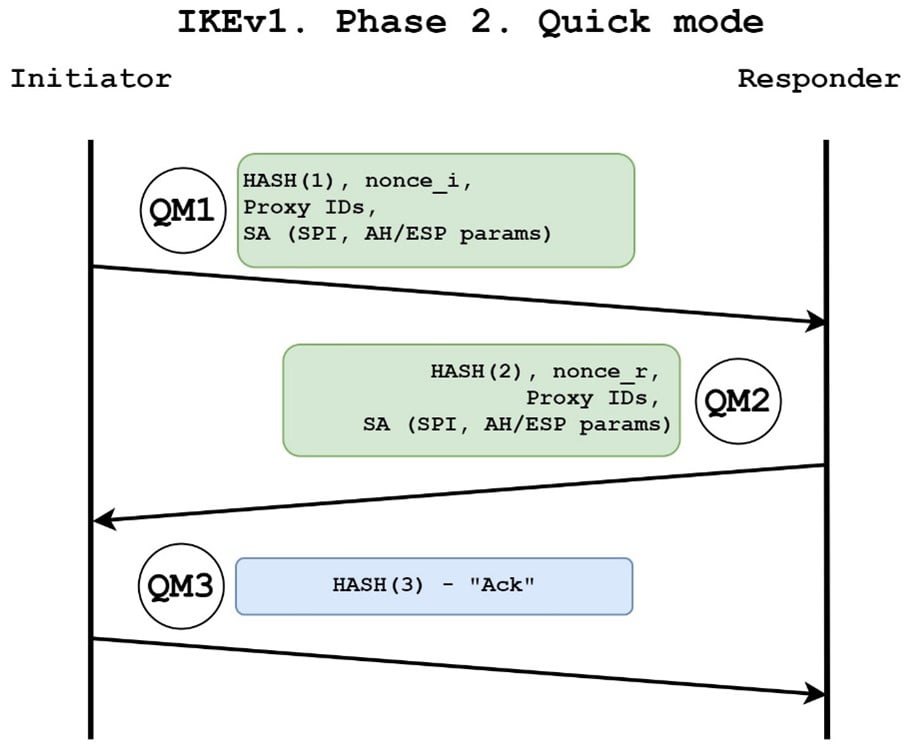
In Quick Mode, 3 messages are exchanged which basically contains the parameters/ protocols/ algorithms to be used for the data plane. Once this negotiation is completed, User traffic (data plane) can be started moving on the IPSEC tunnel.
Quick Mode Message-1: Initiator sends this packet which contains majorly 3 important things. One is the protocol of encapsulation to be used for data plane whether ESP or AH, Second is the Encryption algorithm to be used for encrypting data plane traffic and third is the Hashing Algorithm to be used for integrity check of data plane traffic. This message is sent in an encrypted packet.
Quick Mode Message-2: Responder sends this packet to the Initiator containing its own parameters/protocols/algorithms for encapsulation, encryption, hashing. This message is also encrypted.
Quick Mode Message-3: Once the parameters match on both ends for data plane traffic exchanged in Quick Mode Messages 1 and 2, the initiator sends a message to start the data plane traffic. This message is also encrypted. After these 3 messages of Quick Mode, User traffic can be sent over an IPSEC tunnel using the parameters NEGOTIATED IN Quick Mode.
IKEv2:
How does IPsec work with IKEv2 and establish a secure tunnel between two sites?
As a Network Security Engineer, this is our responsibility to secure your organization’s data over the internet. Our goal is to give you detailed information about How your data would be protected over the internet and Which protocols and Frameworks will be used to protect your data. We already discussed IKev1 working with IPsec. In this blog, we will learn about the IPSEC Site to Site VPN with IKEv2 and how it works.
What is IPsec Site to Site VPN?
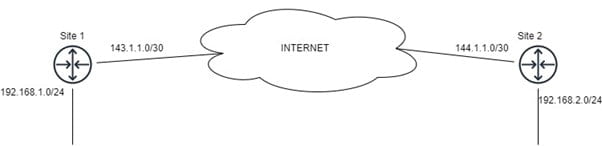
IPsec is a protocol suite, or we can say a Framework that is used to provide a secure tunnel between two sites along with confidentiality, Integrity, and Authenticity. For E.g. There are two sites that are in different regions and their LAN users want to communicate with each other. As we know Private IPs are not routable on the internet. That’s where IPsec helps us to communicate to two different sites’ private networks over the internet with confidentiality, integrity, and authentication.
What is IKE (Internet Key Exchange)?
The IKE (Internet Key Exchange) is a standard that is used by the ISAKAMP protocol for negotiating the parameters. It works with IPsec that is used to set up encrypted, authenticated communication tunnels between two IPsec peer devices.
There are two versions of IKE: –
IKEv2 Phases
Like IKEv1, IKEv2 also has a two-phase negotiation process to create a secure tunnel. The first phase of IKEv2 is IKE_SA_INIT and the second phase of IKEv2 is IKE_AUTH.
Phase 1 Messages
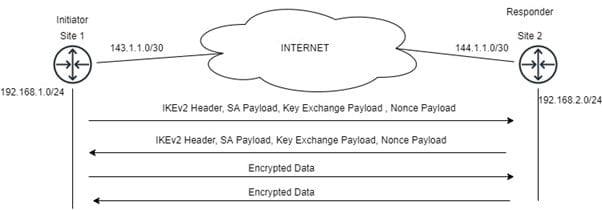
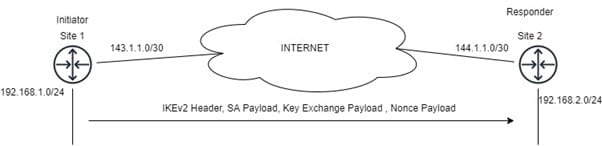
IKE_SA_INIT_Request: – The first message is sent from Initiator to a responder. This message is used to negotiate the encryption and hashing algorithm in Security Association Payload and Public Parameter of Diffie Hellman in Key Exchange Payload and Nonce Payload.
IKE_SA_INIT_Response: – The second message is sent from the responder to an initiator. In this message, the responder sends an agreed cipher suite and its own Diffie Hellman Parameter and Nonce Parameter.
After Message 2 Phase 1 tunnel negotiation is completed and both IPsec peers generate a SKEYSEED which is used to derive the keys in IKE_SA.
Phase 2 Messages
The 3rd message of IKEv2 phase 2 (IKE_AUTH_Request) and the 4th message of IKEv2 (IKE_AUTH_Response) are encrypted and authenticated over the Phase 1 tunnel created by the previous message 1 and 2. In those messages, Phase 2 negotiation is done and both IPsec peers authenticate each other. In Phase 2 negotiation both devices negotiate which IPsec protocol (ESP or AH) is used to encrypt the Data Plane Traffic.
After Phase 2 secure tunnel is created which is used to forward data plane traffic in encrypted format over the internet. We hope this blog is useful to you to understand how ikev2 works with IPsec site-to-site VPN.
We need to understand that there are 2 types of traffic that we need to be aware of while configuring IPSEC.
Control Plane – Traffic generated and destined by/for VPN Device to set up a secure tunnel.
Data Plane- Traffic generated by User Endpoint in plain text, can be destined for another remote user/server.
Before setting up the control plane, you need to decide the IKE version to be used. There are 2 versions of IKE available. IKE Version 1 and IKE Version 2.
IKEv2 is better than IKEv1. Below mentioned are the basic differences between IKEv1 and IKEv2.
We will understand the packets exchanged by IKEv1 in this blog. IKEv2 is just an enhanced version of IKEv1, if IKEv1 is clear then IKEv2 is just a piece of cake.
There are 2 phases and modes in IKEv1. Phase-1 is known as Main Mode and Phase-2 is known as Quick Mode. There is a total of 9 messages that get exchanged in IKEv1 out of which 6 messages get exchanged in Phase-1 (Main Mode) and the remaining 3 messages get exchanged in Phase-2 (Quick Mode).
Phase-1 (Main Mode)
Main Mode Message-1: The very 1st packet is sent by Initiator Tunnel Endpoint to Responder Tunnel Endpoint. This message contains the proposal of the Security Association which contains the Encryption, Hashing, Authentication, DH group, and Lifetime. Also, this message contains the Initiator cookie. This message is unencrypted.
Main Mode Message-2: The 2nd packet is sent by Responder Tunnel Endpoint to Initiator Tunnel Endpoint in response to the 1st message. This message contains the Encryption, Hashing, Authentication, DH group, and Lifetime proposed by Responder. Also, this message contains the Initiator cookie as well as the Responder cookie. This message is unencrypted.
Main Mode Message-3: If the algorithms shared in the Message-2 match with the Initiator, then only Initiator will proceed further with the 3rd packet. In the 3rd packet, Initiator sends a Diffie Hellman Public key along with the Nonce Key of Initiator. This message is unencrypted.
Main Mode Message-4: Responder replies with its Diffie Hellman Public key and the Nonce key of the responder. This message is unencrypted.
Main Mode Message-5: Initiator sends an ICV/Digest/Hash Value of its own Preshared key in encrypted format for authentication. This message is encrypted.
Main Mode Message- 6 Responder sends an ICV/Digest/Hash Value of its own Preshared key in encrypted format for authentication. This message is encrypted.
Once the Hash value (digest of Preshared Key) matches on the IPSEC peers, they move further to the 2nd Phase of IKEv1 i.e. Quick Mode.
Before moving on to the Quick Mode, You must be thinking about what the Nonce Key is, Initiator/Responder Cookie, Diffie Hellman Public key. So, Nonce Key and Cookie are the random values generated by both Initiator and responder. These keys help in generating the Session Key IDs which will be ultimately used for encrypting the further IKE messages, encrypting the data plane (ESP) traffic, integrity check of data plane packets using HMAC. DH we know as an Asymmetric Algorithm used for key exchange and generating the common shared secret.
Below mentioned are the Session Key IDs that get generated on both the tunnel endpoints after the 4 messages are exchanged. Session Key ID is a number created by a mathematical algorithm called “Pseudo-Random function (prf)”. Below mentioned are the formulas of SKEYIDs.
SKEYID= prf (Pre Shared Key + Nonce Value of Initiator + Nonce Value of Responder).
This Session Key ID will be the same on both the IPSEC peers because both have the same preshared key and Nonce Values exchanged during the 3rd and 4th packet.
SKEYID_D= prf (SKEYID + Initiator Cookie sent in 1st packet + Responder Cookie sent in 2nd packet + Shared Secret generated by the Diffie Hellman algorithm after exchanging Public Keys in 3rd and 4th Message). This SKEYID_D will be used for encrypting and decrypting the data plane traffic encapsulated with ESP.
We know that there is a total of 9 packets get exchanged in IKEv1 to set up the tunnel for the data plane. As of now, 4 packets are exchanged which were unencrypted but from the 5th packet, all remaining packets will be encrypted. For encryption we need a key, This SKEYID_E will be used for encrypting ISAKMP Packet 5 to ISAKMP Packet 9.
Phase-2 (Quick Mode)
In Quick Mode, 3 messages are exchanged which basically contains the parameters/ protocols/ algorithms to be used for the data plane. Once this negotiation is completed, User traffic (data plane) can be started moving on the IPSEC tunnel.
Quick Mode Message-1: Initiator sends this packet which contains majorly 3 important things. One is the protocol of encapsulation to be used for data plane whether ESP or AH, Second is the Encryption algorithm to be used for encrypting data plane traffic and third is the Hashing Algorithm to be used for integrity check of data plane traffic. This message is sent in an encrypted packet.
Quick Mode Message-2: Responder sends this packet to the Initiator containing its own parameters/protocols/algorithms for encapsulation, encryption, hashing. This message is also encrypted.
Quick Mode Message-3: Once the parameters match on both ends for data plane traffic exchanged in Quick Mode Messages 1 and 2, the initiator sends a message to start the data plane traffic. This message is also encrypted. After these 3 messages of Quick Mode, User traffic can be sent over an IPSEC tunnel using the parameters NEGOTIATED IN Quick Mode.
IKEv2:
How does IPsec work with IKEv2 and establish a secure tunnel between two sites?
As a Network Security Engineer, this is our responsibility to secure your organization’s data over the internet. Our goal is to give you detailed information about How your data would be protected over the internet and Which protocols and Frameworks will be used to protect your data. We already discussed IKev1 working with IPsec. In this blog, we will learn about the IPSEC Site to Site VPN with IKEv2 and how it works.
What is IPsec Site to Site VPN?
IPsec is a protocol suite, or we can say a Framework that is used to provide a secure tunnel between two sites along with confidentiality, Integrity, and Authenticity. For E.g. There are two sites that are in different regions and their LAN users want to communicate with each other. As we know Private IPs are not routable on the internet. That’s where IPsec helps us to communicate to two different sites’ private networks over the internet with confidentiality, integrity, and authentication.
What is IKE (Internet Key Exchange)?
The IKE (Internet Key Exchange) is a standard that is used by the ISAKAMP protocol for negotiating the parameters. It works with IPsec that is used to set up encrypted, authenticated communication tunnels between two IPsec peer devices.
There are two versions of IKE: –
IKEv2 Phases
Like IKEv1, IKEv2 also has a two-phase negotiation process to create a secure tunnel. The first phase of IKEv2 is IKE_SA_INIT and the second phase of IKEv2 is IKE_AUTH.
Phase 1 Messages
IKE_SA_INIT_Request: – The first message is sent from Initiator to a responder. This message is used to negotiate the encryption and hashing algorithm in Security Association Payload and Public Parameter of Diffie Hellman in Key Exchange Payload and Nonce Payload.
IKE_SA_INIT_Response: – The second message is sent from the responder to an initiator. In this message, the responder sends an agreed cipher suite and its own Diffie Hellman Parameter and Nonce Parameter.
After Message 2 Phase 1 tunnel negotiation is completed and both IPsec peers generate a SKEYSEED which is used to derive the keys in IKE_SA.
Phase 2 Messages
The 3rd message of IKEv2 phase 2 (IKE_AUTH_Request) and the 4th message of IKEv2 (IKE_AUTH_Response) are encrypted and authenticated over the Phase 1 tunnel created by the previous message 1 and 2. In those messages, Phase 2 negotiation is done and both IPsec peers authenticate each other. In Phase 2 negotiation both devices negotiate which IPsec protocol (ESP or AH) is used to encrypt the Data Plane Traffic.
After Phase 2 secure tunnel is created which is used to forward data plane traffic in encrypted format over the internet. We hope this blog is useful to you to understand how ikev2 works with IPsec site-to-site VPN.
x
Cookie-Zustimmung verwalten
Unser Webseiten Template mit den darin inkludierten Plugins verwendet Cookies. Sie stimmen der Nutzung von Cookies und unseren Datenschutzbestimmungen zu.
Funktional
Immer aktiv
Die technische Speicherung oder der Zugang ist unbedingt erforderlich für den rechtmäßigen Zweck, die Nutzung eines bestimmten Dienstes zu ermöglichen, der vom Teilnehmer oder Nutzer ausdrücklich gewünscht wird, oder für den alleinigen Zweck, die Übertragung einer Nachricht über ein elektronisches Kommunikationsnetz durchzuführen.
Vorlieben
Die technische Speicherung oder der Zugriff ist für den rechtmäßigen Zweck der Speicherung von Präferenzen erforderlich, die nicht vom Abonnenten oder Benutzer angefordert wurden.
Statistiken
Die technische Speicherung oder der Zugriff, der ausschließlich zu statistischen Zwecken erfolgt.Die technische Speicherung oder der Zugriff, der ausschließlich zu anonymen statistischen Zwecken verwendet wird. Ohne eine Vorladung, die freiwillige Zustimmung deines Internetdienstanbieters oder zusätzliche Aufzeichnungen von Dritten können die zu diesem Zweck gespeicherten oder abgerufenen Informationen allein in der Regel nicht dazu verwendet werden, dich zu identifizieren.
Marketing
Die technische Speicherung oder der Zugriff ist erforderlich, um Nutzerprofile zu erstellen, um Werbung zu versenden oder um den Nutzer auf einer Website oder über mehrere Websites hinweg zu ähnlichen Marketingzwecken zu verfolgen.


After Message 2 Phase 1 tunnel negotiation is completed and both IPsec peers generate a SKEYSEED which is used to derive the keys in IKE_SA.
After Phase 2 secure tunnel is created which is used to forward data plane traffic in encrypted format over the internet. We hope this blog is useful to you to understand how ikev2 works with IPsec site-to-site VPN.